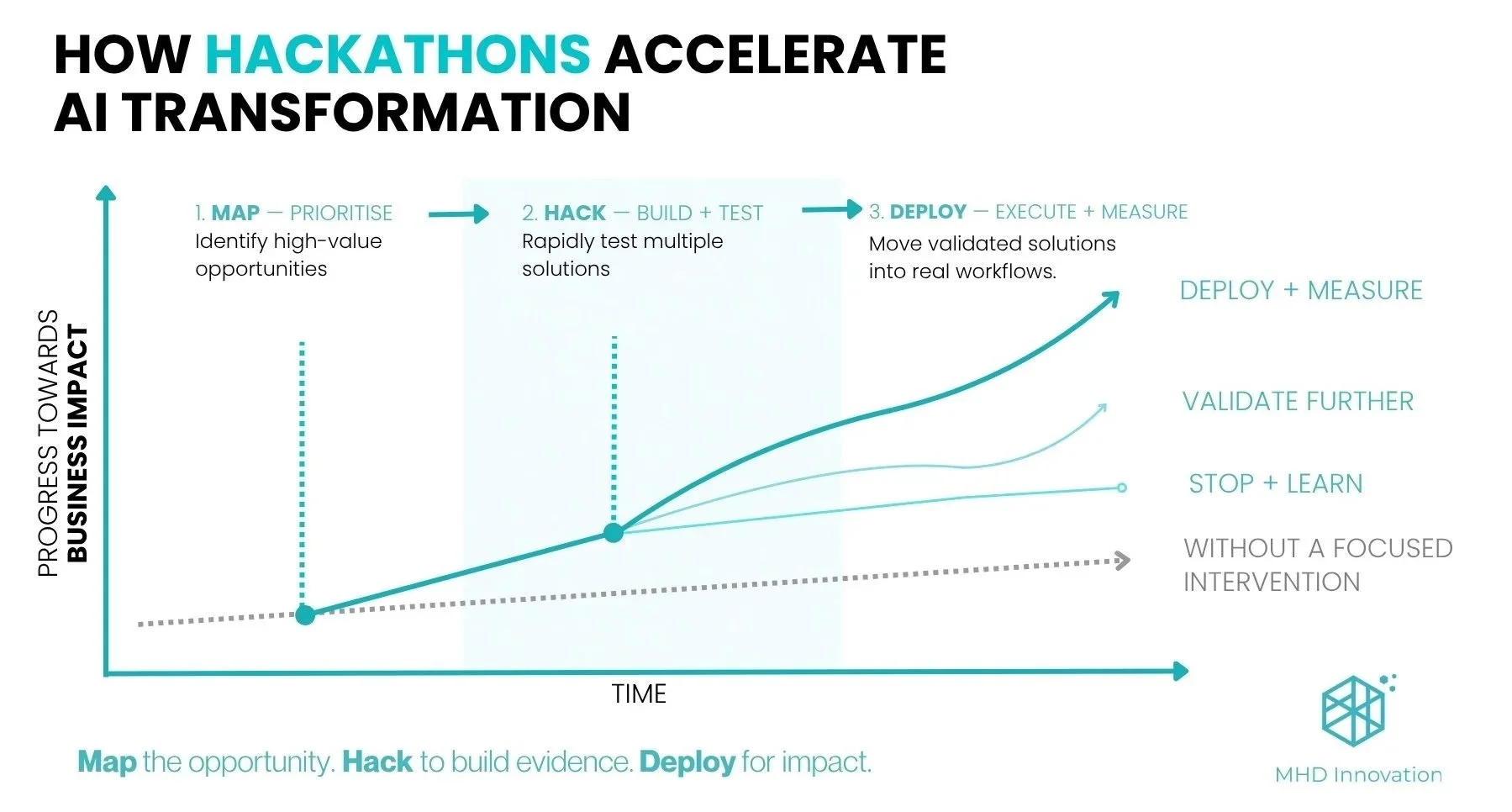
How Corporate Hackathons accelerate AI Transformation inside companies
Your next AI opportunity may already be inside your company
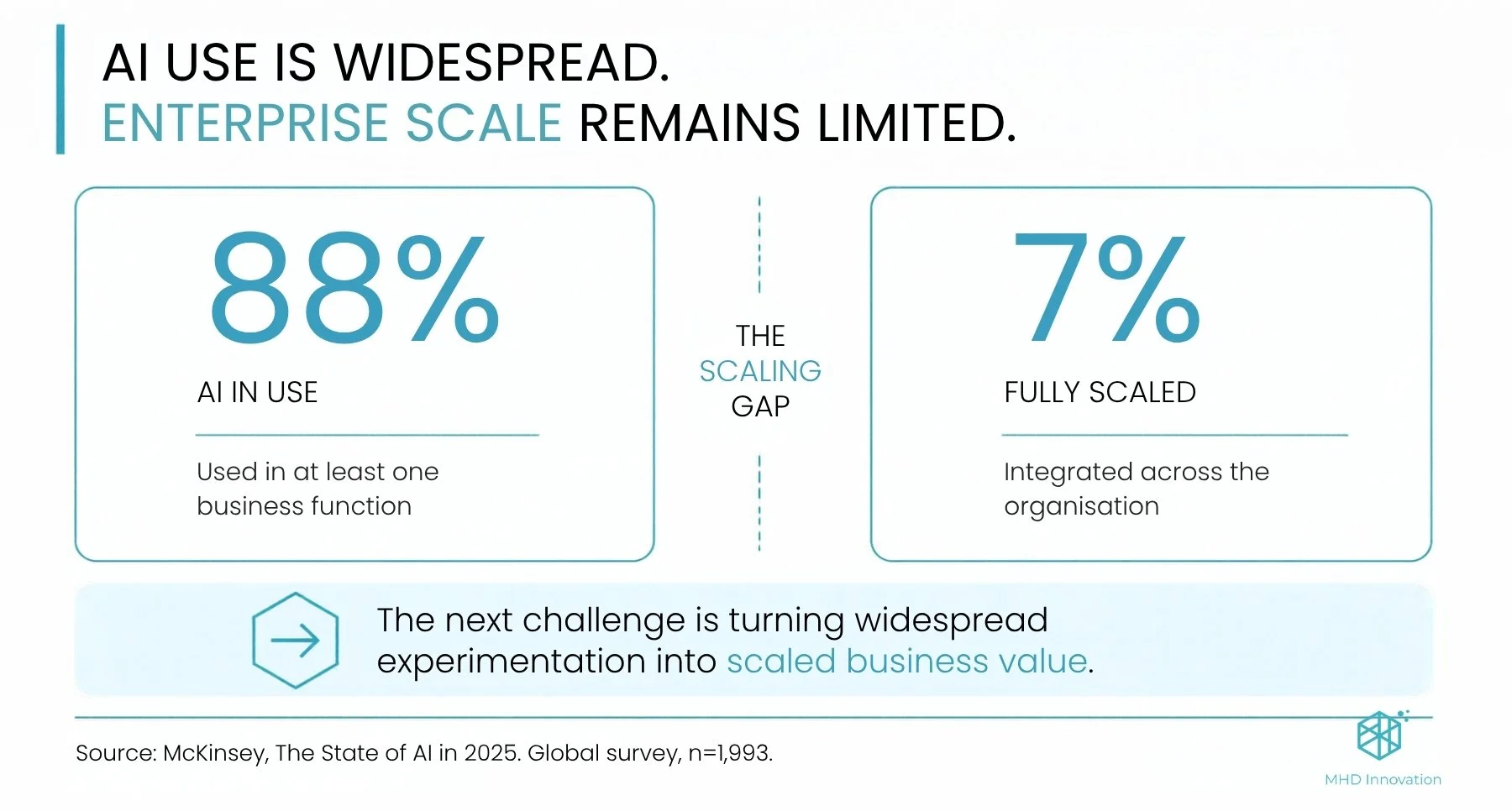
McKinsey’s 2025 global survey found that 88% of organisations are using AI — but only 7% have fully scaled it across the organisation.
The technology is spreading. The harder part is turning experimentation into meaningful, measurable business impact
And the experimentation is already happening inside companies. Nine in ten employees report using generative AI for work, yet only 13% consider their organisation an early adopter.
The problem, then, isn’t necessarily a lack of ideas. Employees know where the repetitive tasks, customer frustrations and operational bottlenecks are. What they often lack is a structured way to explore those opportunities, collaborate across functions and test what might actually work.
That’s where a well-designed corporate AI hackathon can help.
By bringing business expertise, technical capabilities and user needs into one focused process, hackathons turn abstract AI ambitions into real use cases, prototypes and decisions about what happens next.
1. Why AI transformation stalls
The challenge for many organisations is moving from experimentation to adoption.
McKinsey found that nearly two-thirds of respondents said their organisations had not yet begun scaling AI across the enterprise in 2025. McKinsey — The State of AI 2025
There are practical reasons for this gap. Promising AI use cases can remain trapped within departments. Employees may spot opportunities but have no clear route for proposing or testing them. Business and technical teams may explore AI separately rather than solving problems together.
Skills are another barrier. Deloitte's 2026 research identifies insufficient worker skills as the biggest barrier to integrating AI into existing workflows.
The result is a familiar pattern: plenty of AI experimentation, but fewer ideas making the journey from opportunity → tested solution → deployment → measurable impact.
2. What a corporate AI hackathon does differently
A hackathon creates a temporary environment where those barriers can be tackled together.
Teams work on real business, customer or operational challenges, bringing together people who understand the problem, people who understand the technology and people who understand the user.
The objective isn't to use AI for the sake of it. It's to explore where AI can create genuine value — and where it can't.
A well-designed AI hackathon can therefore help organisations:
Identify and prioritise relevant AI use cases
Bring business, technical and operational teams together
Rapidly test assumptions and ideas
Build early AI prototypes or proof-of-concepts
Surface technical, operational and governance risks
Give leadership concrete projects to evaluate
The hackathon becomes a structured AI experimentation process.
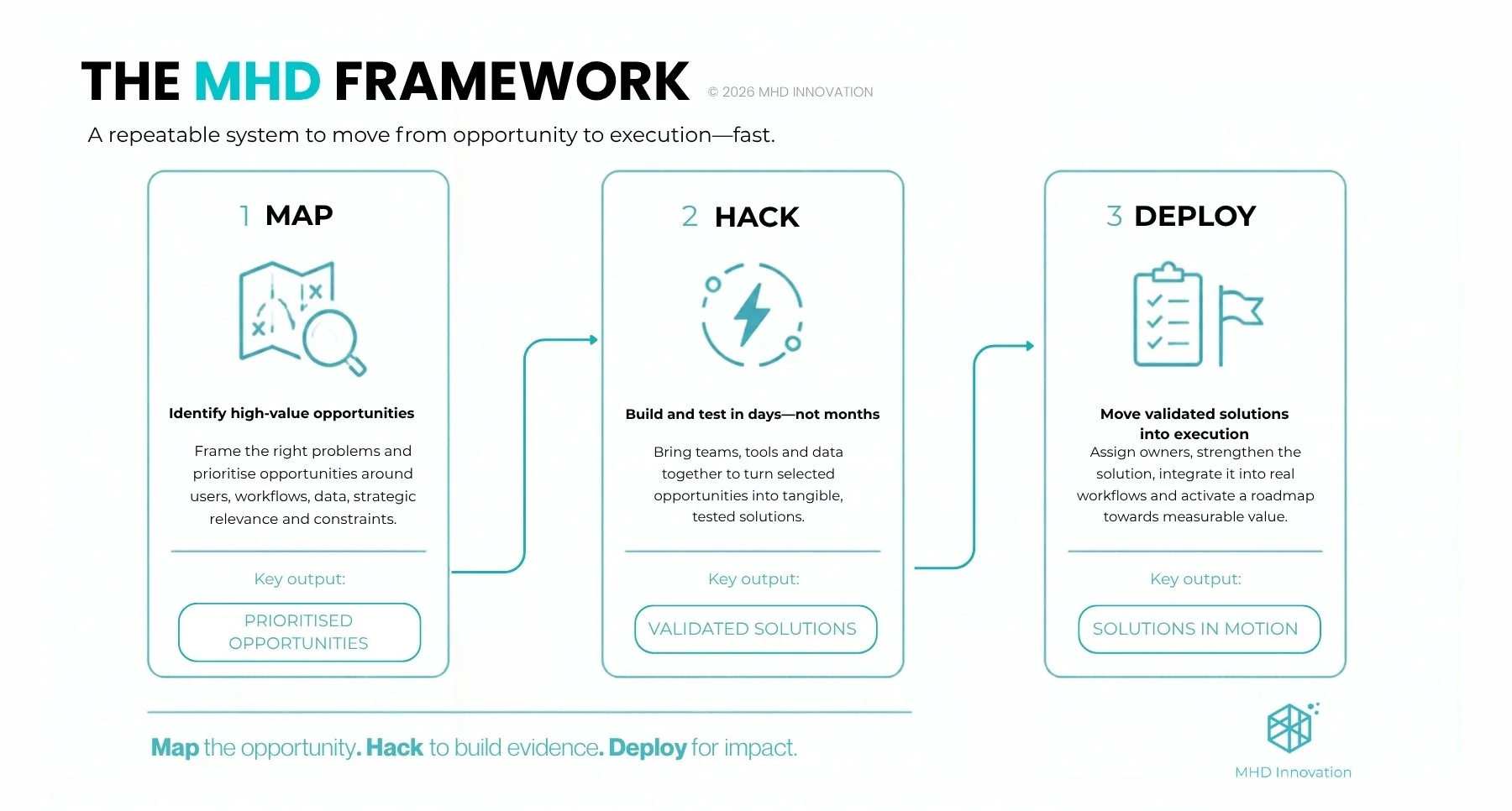
At MHD Innovation, we structure this wider journey through Map–Hack–Deploy. Map frames and prioritises the right opportunities. Hack creates the focused environment for teams to build evidence. Deploy assigns ownership and moves validated solutions into real workflows.
3. What comes out of an AI hackathon?
The most useful outcome is a clearer view of what’s worth pursuing next.
A strong AI hackathon can produce:
Prioritised opportunities — a clearer view of where AI could improve products, services, processes or employee experience.
Early products — tangible demonstrations that help teams test assumptions rather than debate them.
Evidence and insight — user feedback, technical exploration and identified risks that make the next decision easier.
People ready to continue — cross-functional teams and internal champions who understand both the opportunity and the practical challenges of implementation.
Microsoft's research found that AI power users were 68% more likely to frequently experiment with different ways of using AI, reinforcing the importance of learning through experimentation. Microsoft Work Trend Index
Not every idea should become a product. Good innovation also means finding out quickly which ideas shouldn't move forward.
4. The culture-change bonus
Hackathons change how innovation feels.
Hackathons can also change how employees experience innovation.
AI transformation can feel intimidating when it arrives as a strategy presentation, a new tool or a directive from above. A hackathon makes experimentation participative. Employees work on problems they understand, collaborate outside their usual teams and see how their expertise can contribute.
There is evidence that this kind of participation can have measurable effects.
At Ford, survey data from its global Culture Hackathon showed a 20–40% increase in the proportion of employees who felt they could influence company culture after participating. i4cp — Ford's Culture Hackathon
For AI transformation, that matters. Employees need opportunities to build practical AI fluency, understand where the technology is useful and develop confidence through experience.
The goal is to move the conversation from "What will AI do to my job?" towards more practical questions:
Where could AI remove friction from my work?
What could we improve for our customers?
What should we automate — and what shouldn't we?
5. Turning hackathon momentum into business value
A hackathon can accelerate AI experimentation. It cannot, on its own, create lasting AI transformation.
The difference is what happens afterwards.
The strongest programmes have a clear post-hackathon pathway: executive sponsorship, access to data and technical expertise, responsible AI and governance support, named owners and a realistic route to deployment, measurement and continued investment.
Some ideas will move forward. Others will need more validation. Some will stop.
That's the point.
The hackathon creates acceleration. The follow-through converts that energy into business value.
What now?
Your employees are already experimenting with AI. The opportunity is to turn that experimentation into business opportunities worth testing.
A corporate AI hackathon brings teams through a focused process of problem-framing, workflow analysis, use-case prioritisation and rapid prototyping — with business, technical and user perspectives in the room.
The result is tangible: a prioritised portfolio of AI use cases, tested concepts, early prototypes and clear recommendations for what to deploy, validate further or stop.
Start with the problem, then assess where AI can create genuine value.
Exploring how a hackathon could support your innovation or AI transformation goals? Book a Call today